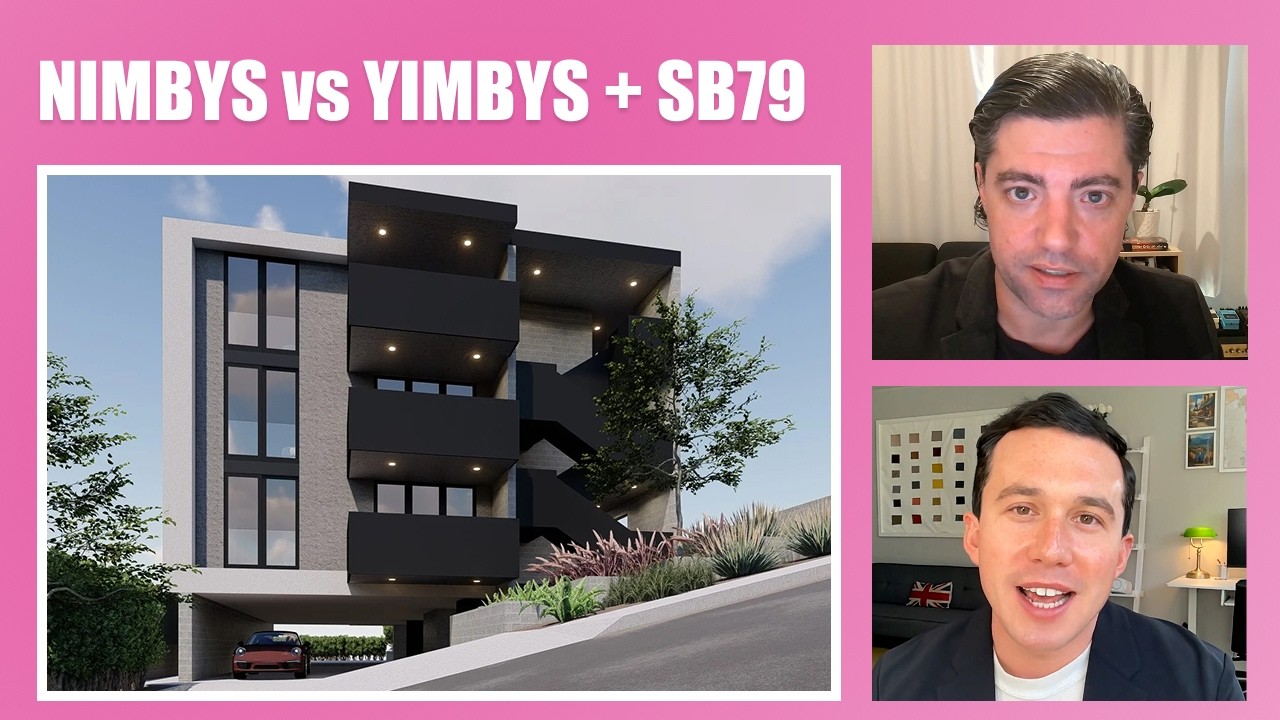
00:00Baileyon this podcast we've talked about San Diego's housing crisis, the parking problems, and of course the complex permitting challenges that go along with building. In this city Today we're gonna look at how California is trying to solve some of these issues, at least at the state level with SB 79 a law that's supposed to unlock more housing near public transit areas.
But as of course, with most things when it comes to California housing legislation, the reality is much more complicated than the headlines make it seem. So, Sean, can you break down what SB79 is? And what it's actually trying to accomplish in California.
00:42Sean CanningYeah, no problem Bailey.
So, SB79 is basically a Senate bill that allows for, at the simplest level, increase in density by qualifying mass transit stops generally within. To a half a mile as the crow flies mass transit. So specifically it will increase the floor area ratio and the height limit of anything that is within that half mile.
So it's overriding local zoning.
01:15BaileyAnd then to be clear, what is the current status of the bill? Is it active law pending? Still up for debate.
01:22Sean CanningSo it's on Newsom's desk right now for signature. If Newsom signs this, it becomes law. So it's basically at the finish line. And the deadline for the signature is October 12th, so less than 10 days from when we're recording this podcast.
01:37BaileyOkay, and so what is the consensus? Do people think it's gonna pass? Will it get signed?
01:43Sean CanningWell, you know, how things go in California. It's always a little bit of a mixed bag. There's certainly a lot of opposition and we can get into why there's opposition. in, San Diego specifically, our mayor hasbasically stated he's in support of this, although he hasn't really come out and championed it. So I guess let's just jump into why you would support this and why you would not support this. basically. There's areas that are locally zoned around mass transit do not allow for density. I can't understand why you would have an area around mass transit that would not be zoned for higher density. So if you support density, next logical step would be, where would you want the density? the only logical. Answer, in my opinion would be you'd want more density near mass transit because areas near mass transit would require less parking. So it makes sense to put, density near mass transit. Now, on the other side, people who do not want SB79 to become law. Those are who live near mass transit that is currently zoned for low density. if you were to make a guess you'd probably be accurate. These are wealthy neighborhoods that have access to mass transit, but do not want mid-rise apartments in their neighborhoods. in county of San Diego, this is be areas like, LA Jolla. Lana Beach and Del Mar, if SB79 passes, you could have eight story buildings popping up in these three neighborhoods. these are wealthy neighborhoods and the communities in these neighborhoods stand on keeping the character of the neighborhood, which does not include 8, 7, 8 story buildings for mass transit.
03:34Baileywho do you think would stand to benefit the most here? W
ould it be the homeowners, developers, renters? Who do you think the winners would be before we eventually talk about the negatives and try and steal man, the case against it?
03:47Sean Canningin the house I'm recording this from, I'm within a quarter mile mass transit, so I would be, and, and it's a a high traffic mass transit stop, so I would be, my property is in the highest tier of what SB79 allows. The lot I own, my lot is only 3,500 square feet, so it may be a little small to build something, eight stories because you wouldn't get the true efficiency of. A double stair elevator structure on a, on a lot this narrow. as a homeowner, my property value is now increased because the potential to build is also increased. as a homeowner, I benefit. I was a renter and all of a sudden you had 50 new apartments pop up in the neighborhood, then the renters would benefit because that would create more competition in the market.
Driving rents down. As a developer, you have to look at where the incentive is. So as a developer, I would say, okay, well I used to be able to build, let's say five units on that lot, now I can build 50 units on that lot. So there's an incentive for the developer to use SB79. And actually there's a couple more fine points about SB79 that would benefit the developer. is a. By right process, so ministerial permit, not a discretionary permit. It is also supposed to come with a very specific timeframe for review, which I think is 60 days per review, which actually should be shortened. Beyond that, you don't need 60 days review a plan like this. So that's another benefit. And the other components here, which I didn't mention earlier, is there has to be, it's required to participate in SB nine. There has to be a percent of affordable housing. I think it's somewhere between like eight and 13% or something along those numbers. But you of course can do more affordable housing if you, if the developer chooses. So the affordable housing, again, would help the renter tore SP nine is, is basically an incentive program. You're going to. You're going to benefit by the additional height and the additional FAR, you have to provide affordable housing. So if you do these things, you get the developer gets the benefit. So all three of those people win. Now if you're looking at it from the other side, other side of the coin, this is how people in La Jolla and Solana Beach and Delmar are gonna be looking at this. They're going to say the homeowner loses because all of a sudden you could have a mid-rise. Pop up next door to you, which is true. They're gonna say that it hurts the character of the neighborhood because the character of the neighborhood did not have mid rises. The renters? Well, I don't know if NIMBYs would have an argument for how this would detrimental to a renter. I think their argument would probably be the character of the neighborhood does not have as many renters, so I don't know if they would say that the, the renter would suffer and, in terms of the developer, I think most NIMBYs would not favor anything that benefits a developer. So I think the only counterpoints here, from my perspective, it's, it's pretty clear here. The only counterpoints is how this affects existing neighborhoods.
just how big of a deal do you think this would actually end up being? This is a bit different than some of the topics we've talked about in the past because this is a state level, um, initiative versus something more local at the city level.
So how big of a deal would it be, do you think? Is it something that like the average person would've notice or do you think like. Just, you know, walking about 10 years later on, you would actually see a massive difference in various cities across California.
07:27Sean CanningYeah, that's a good question.
I guess, I guess everything to answer that question, I have to kind of like just theorize a little bit. Cities would be affected more than others. If you had a mass transit stop in a city without high population. I don't know if a developer would make a choice to develop a mid-rise in a city like that.
And SB79, by the way, does have, different levels based on how far you are from the mass transit, but also based on how much of a population the city has. So it's not like it allows for, mid-rise. up in the middle of a city that doesn't have a high population. I think cities like Los Angeles could benefit from something like this. San Francisco some of the zoning laws are very antiquated. In San Diego, I'm not sure. I'm not so sure how much of an impact this would have because if you're looking to do a mid-level development rather than a larger development, there's still better incentive programs in my opinion. Like the A DU bonus program, I think has significant benefit as long as the project is still within the scale that is allowed by the A DU bonus program. So basically if the base zone allowed for A height and a floor area ratio. That makes sense to the developer. I think you're still better off using the a DU bonus program in City of San Diego than SB79. But you mentioned over 10 years, and I think that's an important point here.
It's not like this thing passes and then all of a sudden you see these. Mid rises pop up. I think if SB79 passes over the next three years, you're gonna see developers start to take interest of this. And then you're gonna take a couple years to permit a project and then a couple years to build a project. So 10 years is probably about the timeframe where you'd start to see the impacts from SB79, maybe a little less than 10 years. So it's not an immediate change, it's a long-term. Long-term planning, that creates the change. So it's very hard to answer that question. I think some cities benefit more than others.
I think major metropolitan areas would probably have the most to gain from something like SB79.
09:36Baileym
oving on to your personal opinion, as an architect who's working on these types of projects on a daily basis, what are your thoughts on SB79?
09:46Sean CanningWell, just to clarify, I've never done a project that's eight stories, so these would be bigger projects than we could take on at my architecture firm, 10 70 architecture. I think to qualify for SB79, you have to do at least five units. So in the scenario where you would have zoning, that would be so restrictive that it doesn't even allow for five units. I guess we could take on SB79 and do like a 10 unit or a 20 unit development, and that would be within, our capabilities. But think about it like this. If you have a mass transit stop it's not zoned around the mass transit stop to allow for at least five units I mean, what are we doing here? if you want density. That density needs to be around mass transit. That's the most reasonable spot for the density to be. So as SB79 is the state overriding local I would say if local zoning has not already allowed for density near mass transit, then the state has to come in and override local zoning because the local municipality has not done a good job zoning. Their city.
10:54BaileyThat's a good point. And then in your expertise in what development scenarios within the city of San Diego, would you say that something like SB79 becomes very applicable?
11:06Sean CanningWell, where I live right here.
11:07BaileyJust next to the trolley stop. I mean, this is probably a great location for people to build 6, 7, 8 story units with limited parking the people who live in these units maybe do not need to have a car. And I know, I understand that's not always the case.
11:25Sean CanningAnd a lot of times people who live next to mass transit also have a car. If there ever was a spot where you could build housing that wouldn't require a car or wouldn't require parking, it's gotta be by mass transit. Right. So it seems pretty like self-explanatory to me. Now I guess let's take those three cities that I mentioned and let's talk about. what that means for La Jolla, Solana Beach, and Delmar. all three of these areas very high-end neighborhoods. Like, I mean, if I had to throw a number at the cost of the average property in Delmar, it's gotta be like $5 million. And these neighborhoods also generally are against, they're almost always against density and they almost always come back to the character of the neighborhood as the reason they're against density. But, let's just focus on that argument right now. The character of the neighborhood. I think it's a little bit of a strange argument because the character of the neighborhood that they're trying to preserve now is different than the way the neighborhood looked 50 years ago, and that's different than the way the neighborhood looked 75 years ago. So Delmar in the 1950s probably had a lot less roads, quite a lot less businesses. So a neighborhood inevitably transitions and grows and changes. so to just kind of like put your heels in the sand and try to prevent that seems to be like a very peculiar take on. Development of a community, and it's something that I guess I'm not, I don't quite understand. I understand these neighborhoods are gonna fight this thing on the stance that there's gonna be more parking, there's gonna be more people, and now there's gonna be taller buildings. But. neighborhoods also benefited from the proximity to mass transit. So like if you live in Delmar and you want to get up to Los Angeles, you could jump on the coaster and get to Los Angeles without driving. And that same benefit could be shared by a greater community of people who live right next to mass transit. So, I dunno, it's kind of interesting to hear both takes. I just think it's very, my opinion, 'cause you asked me my opinion specifically. My opinion is there shouldn't be low density housing near mass transit.
13:53BaileyThat makes sense in terms of the, uh, neighborhood character points, I think you make a good point, but is it in more so like, let's take like a standard residential type neighborhood. Not many commercial businesses, very low story type buildings. From an architectural design perspective, don't you think it's possible to maybe start developing, not even like huge high rises, but perhaps you know, four or five story type buildings that are still designed in the same architectural style?
So it's very cohesive because I think there's a difference between the structure versus the design of the structure.
14:26Sean CanningSB79 is very clear that it still allows the municipality to control the style of the building, which I wanna get back to this point. But one more thing about SB79, if the developer feels that a four story building is more appropriate than an eight story building, if they fell in the category where they could build eight stories, but the developer thinks four stories is more appropriate. Maybe because the amount of units they feel fits the market better. Maybe because they feel like there would be a lot of backlash from the community, or maybe backlash from renters on an eight story building, or maybe because they just want to invest half. The money to build the structure than they would if it was twice as big. The developer can still build a four story building or a three story building using SB79. So like some of the zoning could be so restrictive that it only allows for a 30 foot tall single family building. that's the type of zoning that this is going to completely change. but back to your point of like, should. The aesthetic of the building, the design of the building meets the neighborhood, or be consistent with the neighborhood. I think that's a very slippery slope because, obviously there's been like innovation in architectural styles. We're not still building the same. Style of homes that we built when these areas were settled, there was, there's been different changes a progression of styles. So like maybe a good example of this is a lot of homes when San Diego was settled, where Craftsman style, there's been different movements, like mid-century modernism. for somebody to say, Hey, we have to always build within the character of the neighborhood, would mean never would've gotten to mid-century modernism because we would've been stuck in restrictive craftsman styles. I people are afraid of ugly buildings. think. You really need to leave that up to the architects. that's what we do for a living. Architects have a greater understanding of the context of architectural styles, so when the general public says, oh, this style is ugly and this style is not ugly. I just feel like don't have the full perspective that somebody who studies these types of things would have. I'll give you a couple examples of this. often if you were to look at a brutalist style building, general public would probably say. That is a very ugly building or that's a concrete monolithic building that doesn't have any windows or something along those lines. You know, if I ask my mom if this modern building is attractive, she says no. But if you look at just this specific style of brutalism, it's now become incredibly trendy with. celebrities. Now that's been kind of a newer trend. I think Beyonce and Jay-Z just bought a Tao Ondo home that's distinctly brutalist and it's one of the most expensive homes in the whole country. But also the Salk Institute designed by Louis Kahn is one of the top five examples of American modernism. Renowned for its beautiful architecture, and it's also a brutalist style building. So this may be a little bit of a broader conversation, but I do not. Agree with municipalities creating any type of design restriction on architects.
And that does mean that you're gonna end up with ugly buildings next to beautiful buildings. You know, why do more attractive people look more attractive? because there's less attractive people out there. So it's the difference that creates the interest. Maybe another good example of this would be like the Louvre in Paris and the glass pyramid.
Like nobody would've expected IPE design the glass pyramid. at a site as historic as the Louvre. But now looking back in hindsight, you can see the contrast of styles is what makes it interesting the contrast of styles is what makes the new builds. Difference than the old build. So you can see where the historic character is. because the pyramid wasn't built to be a replica of the historic structure, it's built to be unique, which is what really shows how cool the historic structure is. let me break this down to a very small level. when we built one of the first ADUs we ever built for ourselves, the Prince House, There's a single window on the front facade, and we had to do that because the building code required there to be at least, I think it was at least 10 square feet of windows on the front facade or something like that. Now, I know most people would say, you should have a window on the front of your building. This building faces The driveway. So there really, you don't want a window on the front of the building. as the architect, I'm not so sure I would've put a window on the front of the building if it wasn't required by code. when the municipal code just has this, one arbitrary design requirement, sometimes it can be inconsiderate of what the architect's idea. Is or what the architect's perception of beauty is, or even inconsiderate of the site constraints you don't want a window that faces your car when you pull into the driveway. because it was a two story building, I was able to put the window on the second story. design constraints for architects are a very slippery slope. What is the character of the neighborhood is a very slippery slope. We wanna build things that are with respect to the historic character of the neighborhood, but there's ugly historic buildings and there's beautiful historic buildings a lot of it comes down to just how you perceive buildings. Butin most cases, the architect is going to have a higher level of understanding of this. It's like if you went to a museum and you were like, man, all this modern art is really ugly. But then there's an art historian is like, well, that one actually is like that because of this.
And you know, this one is like, like that. Because of this an art historian is going to understand art in a way that you and I. Do not understand art. A musician is going to understand music a way that the general public is not going to understand music. I mean, look how popular Taylor Swift is and then look how many unbelievable musicians are out there that nobody knows. And as a musician, sometimes it's more interesting to listen to music that is less pop, sensible. Like you would get with Taylor Swift, like there's a place for Taylor Swift, but there's also a place for all these really talented musicians that are doing unique things and kind of breaking outside the mold.
21:14BaileyYeah, I think back to your main point about how you don't wanna lock yourself into one specific design style. I think in summary, essentially you argue that it halts innovation, which I did not consider. So I think that's something, you know, obviously if you wanna be a part of like a growing city that's becoming more vibrant over time and thus more livable.
21:33Sean Canninga city that maintains the existing character. of an architectural style is, that's a world where we've never reached mid-century modernism. I mean, can you even imagine that it's considered one of the most beautiful styles of architecture distinctly a creation made in the United States if you lock things up behind a municipal code, we would've never had that.
21:53BaileyNow, I imagine the main reason why this is being done, of course, is to combat the housing crisis in the entire state of California. How much of an impact do you actually see this specific bill having on the housing crisis, and of course the homelessness and all the stuff that goes along with it?
22:12Sean CanningI would say what this does primarily is combat a zoning crisis because, you know, in, general city planning, there should be no low density zoning by mass transit. if there is, it's an antiquated zoning policy which is most likely rooted in some sort of segregation or some sort of racist policy to Preserve high value properties by excluding certain people out of neighborhoods. So I would say it's more of a zoning crisis that this is going to fix. And regardless of the housing crisis, I think we should fix the zoning crisis. whether or not this fixes the housing crisis is a. more complicated question, in my opinion. I do think ultimately the housing crisis boils down to us not building enough homes for people. So I do think it is a matter of supply and demand. I don't personally tie the homeless crisis to. The cost of housing, at least not exclusively. I think the homeless crisis also has a lot of aspects of, substance abuse and mental health. maybe cost of living is a third component of that, but I think those first two are probably, much more significant in terms of the housing crisis or the homeless crisis. But, there's another thing I wanted to bring up here, Bailey, and that is how this is being perceived in the city of Los Angeles and maybe this shed some light on the difference between wealthy neighborhoods NIMBYs and at the same time also the housing crisis and the homeless crisis. Los Angeles is having much larger homeless crisis than San Diego, and interestingly enough, the mayor Karen Bass is actually against SB79which is very peculiar to me. it's very strange to me that she would be against this. at the same time, the Palisades fires we've had very little movement in permitting on. completing permits for the Palisades fires, and she's promised to streamline the permitting for those things. But it hasn't happened. while she hasn't been able to push through permits for wealthy neighborhoods like the Palisades, she's also against adding more density near mass transit with SB79.so you have this scenario where two things are true. have people. That are sleeping on the streets in Los Angeles you have, people who cannot afford homes in Los Angeles. People who will be forced out of the neighborhoods they've grown up in because of rising housing costs. And she's focusing on trying to push permits through for wealthy people in the Palisades, which she has not been successful at doing, and also turning down SB79
So sounds a little tone deaf to me that she could be against SB79 while all these other things are going on. I think that's kind of interesting.
And you know what, Bailey, there's one thing that came to my mind. This week that you and I have never discussed, I think out here in California, a lot of people talk about how they cannot afford neighborhood they grew up in.
Like you've heard this sentiment quite a bit. Right?
25:27BaileyDefinitely. Yeah.
25:28Sean CanningBut occurred to me this week that
you and I were actually probably some of the first. Maybe not the first, but you and I were in this position in northern New Jersey. I could not afford a home in Bergen County. So if I was to stay in New Jersey, I would've been forced outta my hometown of Paramus. I ended up moving out here and finding a home that was less expensive than what it would've been in Bergen County. you know, you are basically gonna be in the same position and maybe your brother is in the same position right now. He cannot afford a home in the neighborhood that he grew up in. I'd never really considered that because I wasn't planning on staying in that neighborhood. But I guess it rings true with my brother as well. He was not able to afford a home in the county that we grew up in. Have you ever considered it from that perspective that you and I were actually kind of forced out of our home?
26:21BaileyNot in the same way because like you, I had planned to eventually move to Colorado for years before, but I would say, for example, I used to live in Hoboken shortly before I moved out here, Hoboken, New Jersey, across the river from Manhattan. For those that don't know, and the rents there are way more expensive.
And I think often how, like now I live alone in a nice modern apartment, but if I had stayed in Hoboken, I would be spending probably like a thousand dollars more for rent and I would have a worse apartment with like less modern appliances. I would've a roommate. It would be smaller, probably all things considered.
So it would be a lower quality of life essentially, just from a pure living standpoint if I had stayed. So yeah, I do think about that. But yeah, I was thinking, I mean, I think that is like kind of like the cheat code in today's current environment where if you are growing up in one of these. High cost of living areas, mostly along the coast, I would say, but it could be any metro area.
I think the key is to move to a cheaper one, so that could be many different things, but I think that's, I mean, that's kind of how you can increase your standard of living automatically, assuming the same income.
27:30Sean CanningThat only applies to people who start at a baseline of a high cost of living area.
27:36BaileyThat's true. Yeah. If you're trying to make a transition the opposite way like many people also do, then it becomes much more challenging,
27:42Sean CanningYeah, but I guess the thing that is evident is like there's no guarantee that the neighborhood that you were raised in is going to maintain a level of affordability that you can live within.
So using things like SB79 to add more housing, to try to control that to the. Best ability possible, I think is a good thing because, you know, not everybody wants to move out of their home state like you and I did, andit is more convenient to live next to your family to kind of consolidate resources, especially if you have kids. So I think that's one of the things that SB79 does, and I think. Putting it next to mass transit makes a lot of common sense, and I just can't seem to understand how there could be low density near mass transit. And by the way, before, there's a bunch of ,comments here that say, well, what about historic properties?
S sp seven, nine does accommodate historic districts and historic properties. So that's all taken into consideration with the bill. And I guess, you know, one more caveat I should make. A lot of times, especially in California, the legislation has. Good intent, but the implementation is where it fails. So I think just to summarize, I think the intent of the legislation is good. We'll see what happens when they implement this, and we'll see how it pans out at that point.
29:03BaileyYeah. I think to round out this conversation, something you've talked about a lot here is the idea that you want to be a part of a growing, vibrant city. Which equals change in some form or fashion. Because the alternative would be, and I was thinking about this recently, you don't need to go back to like the ancient like Roman or Greek times to think about cities that didn't pan out.
Even in America, for example, I believe in like the 1950s, um, I was in the museum recently and they were talking about how Detroit used to be the fourth largest city in America during the 1950s. Now we obviously know what happened to Detroit. I remember being in St. Louis one time at the Arch and there's like a monument talking about the Mississippi River and how important it was for shipping and trade at the time.
But then on the plaque it also talks about how the city of St. Louis peaked population wise, I believe in like the 1850s or sixties, which when I was reading it was strange to me. 'cause I was like, well, why would you still want to be living here a hundred plus years after the city's peaked? But it seems to me that
We can either embrace the updated zoning to accommodate more, you know, higher story structures to increase density. The alternative would be, if you don't wanna do that, but you still want to have a growing city, then I guess you would need to embrace suburban sprawl, which I don't think is, you know, a viable solution, really.
Or the third option would be to just, go full nimby, I suppose, and have it essentially locked out unless you're like super, super wealthy. So, long story short, I think we need to embrace, there's the only solution if you wanna be a part of a growing vibrant city, is to embrace what we've talked about here, which is essentially increased urban density.
30:43Sean CanningYeah, and it's always a reaction of like, what's, happening? Like when the automobile became a thing, cities. Changed, like there's huge changes made. Streets had to become wider. There was probably a bunch of NIMBYs back then that were like, Hey, I don't want roads in my cities.
I know for a fact there was a NIMBY movement that was anti metal. streetlights, they wanted the historic wood streetlights. There used to be guest lamps. We have a whole area in San Diego called the gas lamp quarter, where streetlights were run by guests. They don't do that anymore.
They're electric, so things change. I think the advent of the automobile was one of the things that changed cities the most drastically. And now here we are with, a lot of traffic. we have to plan for a lot of space to park all these automobiles. And now the reaction is we need to start building taller so that we drive less.
31:34BaileyYes.
31:35Sean Canningto the new technology. But we have to continue to change and progress And it's hard for me to understand the logic of somebody who says, no, we have to preserve the existing character of the neighborhood. 'cause what you're really saying is we need to preserve the way things are Exactly. As they are right now, and that seems to be against innovation.
31:55BaileyDefinitely. I think that's a good place to leave it at.
Now say there are developers or someone watching this who is looking to take advantage of perhaps SB79 becoming law, or maybe they're just interested in doing some sort of a multi A DU type development. How can your architecture studio help them and what would be the best ways for them to contact you?
32:16Sean CanningYeah, well after October 12th, we'll find out if SB79 is a gonna be a, a real thing or not. But if you're looking to do some sort of project like this, whether it's an A DU project or a multiple dwelling unit project, Go to our website, 10 70 architecture.com. You can shoot me an email Sean, SEAN, at 1 0 7 0 architecture.com, and you can also check out the Instagram so you can see what some of our projects look like. It's at 1 0 7 0 architecture.