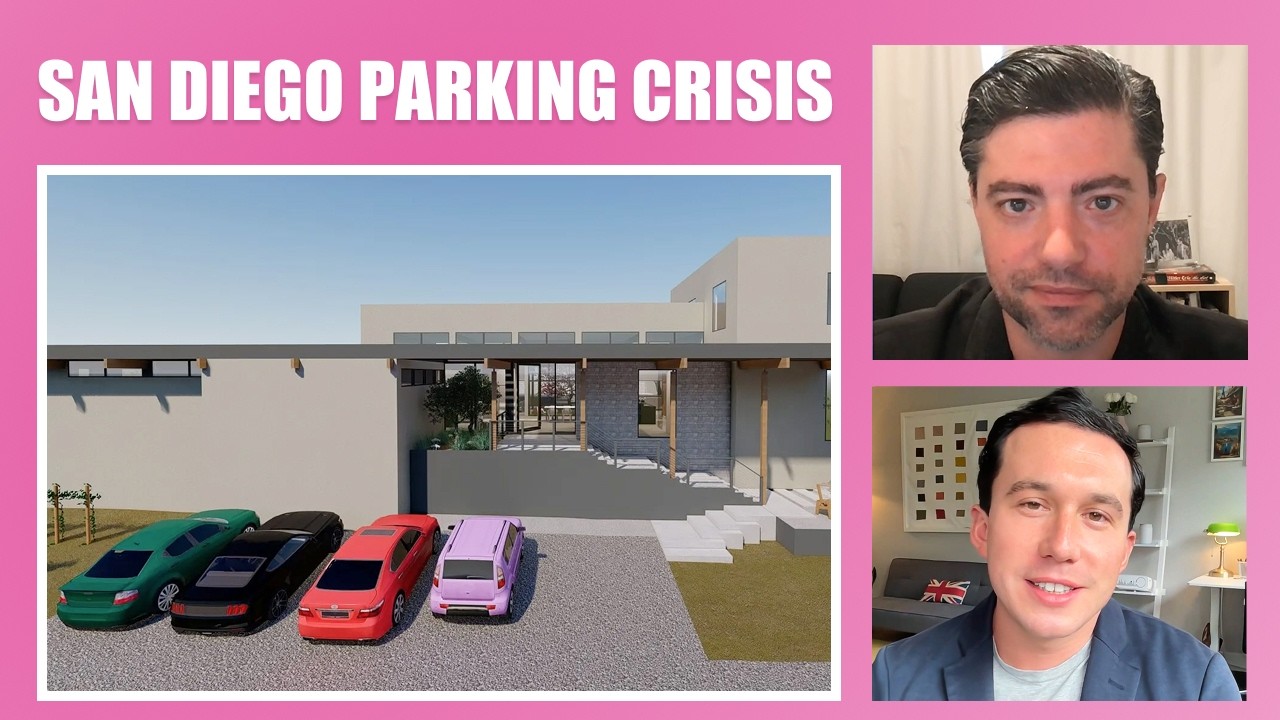
00:00Sean Canninghere in the city of San Diego, we have an incredibly dysfunctional city
parking is developed horizontally, but buildings can be developed vertically
You should never have more cars than you have off-street parking spaces
adding more lanes to the highway, studies show it in-increases congestion rather than reduces traffic
if you don't want your taxes to be put to good use, then that means you're okay with not having density next to transit
why not allow this person to parallel park in front of their own driveway?
a lot of people are not going to be happy about what I said But there are no other solutions
00:31BaileyStarting January 1st, 2027, California's new housing laws make it easier than ever to build. Homeowners can now add two detached ADUs to most residential lots, starter homes get streamlined approval,
and high-rise housing near transit hubs gets fast-tracked, and a lot of these new homes won't even come with a parking space. So naturally, that has everyone asking, "Where exactly is everyone going to park?" So today, we're doing a deep dive all about parking: what the city actually owes you when it comes to parking, why some new units are being built with no parking at all, a real case study of a mixed-use neighborhood built with zero residential parking, and what San Diego actually needs to change to make parking more convenient in the city.
So Sean, parking is one of those topics that people's opinion comes from their everyday life experience. So before we go into the specifics of parking and how it do- dovetails into city planning, let's start with your day-to-day. How do you actually get around in San Diego?
01:43Sean CanningThanks for setting this up, Bailey. Parking is probably the most hotly contested issue when it comes to adding density. So I've spent the last 15 years of my life creating a structure where I don't necessarily need to rely on the car. However this is very challenging, and I understand that not everybody can do it, and it's even more challenging in a city like San Diego, which is really still an, a car-centric city. just a couple of items about how I'm getting around here. So first off where I am right now, m-my wife Margaret and I, who run this business together, we share one electric Fiat, so this is about three-quarters of a car for two people. I also live within three blocks of the Orange line trolley stop, which if the trolley lines improve a little bit that could be a huge asset for us in this area of Logan Heights n- right next to Barrio Logan, San Diego. We also walk a ton. I mean, we probably average about three miles per day on the days when we're not working. We are-- we work from home. We have a extra studio in the back of our single family home where we can work, so we no longer commute. I used to commute about five miles from where I live to North Park.
So, and since Margaret and I work together, we share the car and we carpool, so it was five miles there, five miles back. Now, really the only driving we're doing is either site visits consultations, which could be once or twice a week, mostly we're driving to the dog park. That seems to be The most frequent trip we make, and if there was a local dog park, I would love to not drive there. Also as an architect who designs buildings and homes and a lot of mid-density projects, I'm a huge advocate for practical parking because I realize there is a transitional period where a city goes from a car-centric city like we have now and then trying to retrofit that over a s- a few decades to a less car-centric city.
So right now we're going to be in this transitional period, I'm still an advocate as an architect for people to provide easiest parking possible on their lot. N- I'm not talking about underground parking, I'm not talking about parking, structures. talking about off-street parking that is on grade and designed within the context of the mid-density project.
So we still do that as architects, so I'm not here designing zero parking projects whenever possible. I do believe though, that a project with no parking is still better than a project-- than no project. So let me just rephrase that because I think this may be the most key thing to understand my perspective here. I design for parking, but even if we cannot fit any parking, a project with no parking that provides residential units is still better than no project at all.
04:46BaileyI see where you're coming from. if your choice is between a home or a residential apartment complex and parking, or a home and a r- a residential apartment complex and no parking, you'd rather take one than not the other. Let's set some ground rules first because as we've seen in the comments on some of these most recent videos parking especially can get pretty heated pretty fast.
So what are we assuming the goals and the mindset are going into this conversation from your perspective?
05:16Sean CanningYeah. So it's really important to limit these conversations and put some bumpers on the alley here because otherwise they can go in all different directions. So here's a couple things that I'm gonna state off the top. Within the context of this conversation, we want more density. So if you're somebody who wants no more density here, this is gonna be a difficult conversation for you to participate in. So we're starting-- the starting point here is we want more density. Another important to understand is the zoning that we have in the city is what's going to shape the density. So in areas where we-- where the city of San Diego is zoned for higher density, it's going to be harder to find parking for those areas. And the areas in the city of San Diego which is zoned for lower density, it'll be easier to park there, and I'll show you a diagram that I made to explain this. also just the given here is that density should be located next to mass transit. anybody who would disagree with that means that they are n- they do not want the full value of the cost of that mass transit that we, in most cases, have already paid for. So if you don't want your taxes to be put to good use, then that means you're okay with not having density next to transit. Now there may be some areas that are mid or low density next to transit, and those areas should be up zoned because we already have the transit here. That's like-- That's a-- It seems to be a very easy concept for people to get behind. also, more cars we have on the road, the more accidents we have and the more infrastructure and maintenance we need. So the further we spread out these roads, the more it actually costs us both in safety and in real dollars. And then lastly, like this is probably the concept that I had the biggest epiphany on when I was considering rethinking cities without cars. So you and I, Bailey, we're born into a car-centric life, the United States, more than any other country, was developed around the automobile. And California, maybe more so than any other state, was specifically developed to be car-centric. So everybody in the last hundred years, basically everybody watching this video, their entire life has been born into a car-centric lifestyle, and it can be hard to take a step out of that, because that is the norm, think about what it would look like without cars or how to retrofit our lives to be less car-centric.
Let me do a quick screen share, and I just wanna explain a couple things here. So this is a diagram that I had made up with some AI software, and the goal here is to explain how density works best in relationship with parking. So of course, like And you don't get this different type of density too often where you go from a single-family home all the way up to a five-story mid-rise. But basically what I'm trying to show here is in the center of this area here, we have our higher density zones, and that's where we want our mass transit. Now, mass transit in a lot of scenarios will come first because it's hard... It's very hard to retrofit a city for mass transit 'cause it takes a lot of space and a lot of land, which the city doesn't always own. So where we have our mass transit, we want our highest density. That's also generally where we want our commercial use. And then the further we get away from that city center, we're gonna end up with multi-family housing like this duplex here or maybe this town home here. And that's where we're gonna see a lot of on-street parking you can see there's just not a lot of area for off-street parking.
There's not a lot of driveway space here. And the price of the land is high enough where you'd rather put an extra bedroom in the home than have an off-street parking space. And ideally, this is located close enough where the people who live here could walk to mass transit. Now, in real life, you know, this could be a thirty-minute walk or a half-mile walk, but ideally it's shorter. And then when we get even one step further along the street here, you're gonna find your single-family homes, and those homes will be large enough to have parking in the form of a driveway, which you see here. And in theory, you would have less on-street parking the further you get. If I was to, like, create one more step to this diagram here, you would ha- eventually have rural lands which would have basically no, on-street parking because everybody would be able to park on the lot. So that's a diagram I created to explain this whole thing. Now let me just go one step further here. This is a typical mall, and you can see right here in this image how car-centric this design is. reason you get this is because the municipal codes were written with minimum parking requirements based on the square footage and the use for all these commercial businesses.
So maybe it's every five hundred square feet, you need two and a half parking spaces. And what you end up w-- Basically, what you end up with by the time you develop the land is you end up with a very small in comparison to the size of the lot because you need to accommodate the parking. So this is considered a...
This is a typical American strip mall. We have a ton of these in San Diego. We we have a ton of these in New Jersey where you and I are from. And basically, this is a design where you are thinking about the car first and the pedestrian second. And let's just compare this design to what this could be if we were to retrofit this. So if we reduce parking minimums, and that's basically happened quite a lot in San Diego already, can design these to be more pedestrian-friendly, so less parking here and more alternative ways to get to these places. And also, in addition to, like, other means of transportation to get here, we're also putting, residents above the commercial.
So this is mixed use, and now the people who live here, they don't have to use their car. They don't even have to use their bike to these businesses here. So I guess that is a good explanation for what I would say are the ground rules for this podcast.
11:47BaileyGot it. Very well done. To summarize, what would you say is the core problem that you as an architect and city planner should be actually trying to solve when it comes to making cities denser and more livable and more walkable while still accommodating personal vehicles?
12:04Sean Canningthe starting point for this should be just a comparison of some different some different areas to explain really what density is. So this is our starting point here, and this city is Paramus, New Jersey. This is where I grew up. Wikipedia calls this the quintessential American suburb. And just for comparison, the average home price in Paramus, New Jersey is just over a million dollars, and the average home price in the city of San Diego is just under a million dollars. So they're right there in terms of price. Now, here's the big difference. In Paramus, New Jersey, in the '70s, they banned all multifamily zoning. So all you have here is single-family zones across the entire suburb of Paramus. We're also not allowed to park on the street overnight, so you get very little parking on the street. So if I just zoom in on a random street in Paramus, look, there's two cars parked here, another one over here. But look at the sizes of these driveways and look at the sizes of these lots. Now let's compare that with San Diego. This is the city of San Diego. I just randomly picked a road here. It looks like it's about n- in North Park. And now let's compare. The lots are much smaller, but look at all that on-street parking here. if I flip back, you can really see the difference in terms of density. This is a suburb In San Diego over here in North Park, this is not a suburb. If anything, this is-- this would be considered the urban edge. But I would make a s-- I could make a strong argument that this is part of the city of San Diego not just some, like, something on the side of the city of San Diego. And then we could even contrast that with New York City, which obviously has a much higher density, and you're always gonna have parking on the street here, and you're gonna have mass transit. So we have three different types of cities and density. But the point I'm trying to make here is neighborhoods like North Park are not a suburb. If anything, they're between the city and the suburb, but I really think they're actually closer to the city than they are to a suburb. So people who are arguing that we don't want density here, what their... where their argument lies is where is the edge of the city? That's the-- gonna be their point. Now, this has been the big issue with parking and development. It all stems from basically required o- off-street parking. Here's the city of San Diego's Municipal Code Chapter 14. These are the parking regulations. it kinda breaks things down into two major areas. We have our transit priority areas, and we have outside the transit priority areas. Before this was revised, before we had the transit priority area every single home had this category. So any single-family dwelling unit would require two spaces dwelling unit. Now, if you look at San Diego again, it can be very difficult to accommodate two spaces off-street. So let's take let's just take a random home here Okay, so here's a home.
Let's say this is a garage in the back. I'm not sure that is a garage. If you have alley access, according to the City of San Diego, we cannot have a driveway, so you have no ability to put your parking here. So that means you need two off-street parking spaces here. Actually, let's use this one as an example.
This is a better one. Okay, so you have a home here. No opportunity for a driveway unless there's one existing. But because you have an alley, you now have to put all of your parking this garage structure here. So one home, two parking spaces, we can make this work. As soon as you go to a design that has two homes on a lot this wide, just like this one here, you now need to accommodate four parking spaces. This lot cannot accommodate four parking spaces, nor could this one here. So you ca-- So basically, even though these are zoned multifamily already, you can't a-- you wouldn't be able to get this permitted with two dwelling units because this code here would've res- would've restricted that. So the first major reform came when we implemented the transit priority area, which allows for zero spaces dwelling unit, and this is where the transit priority area lies in the city of San Diego So you could probably tell this is basically the entire city of San Diego, or it's at least two-thirds of the city of San Diego. So anywhere in this yellow here, you do not have to provide parking for residential use. And basically, this allows for us to increase the density and still get our permits. Okay. So let's do one more comparison here. Maintaining the character of the neighborhood is a secondary argument, so I don't wanna conflate the two arguments, but there is a bit of an overlap in the Venn diagram here. There's a lot of naysayers who say we want to maintain the charac-- the existing character of the neighborhood. So let's look at the existing historic character of North Park. This is a bungalow court project right here. There's no driveway. This is the project here in the top view, and we have at least one, two, three, four, five, six...
This could be a duplex, but there's at least six units here, and there's a second story here. So there's maybe somewhere between seven to eight units on this lot. All of the parking is in the alley here in first-floor garages, and there's eight garages if you count them. So in this historic cottag- cottage court, which is undeniably part of the character of North Park, we are under-parked according to the municipal code.
We only have one parking spot dwelling unit here. Now, historically, this is the way you would build neighborhoods, but you wouldn't have been able to build this with this antiquated parking regulation. We need to use the updated transit priority area. Because North Park falls into this area, we can actually design this today with zero parking. Okay, one more here. So this is right across the street in North Park. This is actually probably the most efficient way to park We actually have a tandem spot here, a tandem spot here. So you have one, two, three, four, five, six, seven, eight, nine, 10, maybe 10 or 11 parking spots. Each one is two, so you have 22 parking spots across here. then in this particular lot it was this one here, we also have parking off the alley, so maybe there's another 10 off the alley. So it looks like we may have 32 parking spots here, and this is a design where you would say it could be over-parked. if we're looking at the character of the neighborhood, I mean, what is a nicer design?
Do you wanna see 22 parking spots in the front, or do you wanna see a nice historic cottage court with no parking in the front? are basically the two options. This is a under-parked development, and this is an over-parked development. And I'll just skip ahead real quick. The city actually does not allow these long curb cuts anymore, so you no longer have the ability to do this because this is considered to be a n- not a pedestrian-friendly development. Okay. So long story short, to circle back what has to happen is we have to eliminate minimum parking requirements in areas where public transportation is available, that allows for higher density, which allows for an efficiency of roads, and all of the maintenance that comes with that
19:54BaileyGot it. I think that's a very good setup. We have a couple questions drafted, I believe five here. Do you wanna go through these real quick in sort of a rapid fire just to kind of dispel some common myths people might have about parking and what they think they're owed technically?
20:12Sean CanningSure.
20:12BaileyAll right, so number one, and this is definitely gonna be the most personal one.
People think if I live on a street, isn't parking in front of my house kind of mine? What are your thoughts to that?
20:22Sean CanningI would say not unless it's in your deed. So you own everything that the deed you purchased has. So some people say what about my... Is my view protected?" If the view's in the deed, it's protected. But do you own anything in the street, anything beyond your property line? If it's not in your deed, which most likely it's not, then you actually don't own this. Let me show you an example here. So this is a SketchUp model I built.
20:49BaileyEven if it's not in the deed, people think they're gonna, they own it, you know?
20:53Sean CanningI don't understand that, I don't understand that logic, to be completely honest with you. You can't prevent a pedestrian from walking down your sidewalk, so why would you think you could prevent a visitor from parking in your street? Now, there are different, like, vehicles where you can adjust these things.
So you can do residential permit parking, and that would basically make everybody who parks on the street part of the local neighborhood. You could do metered parking, which I know everybody hates, and city of s- the population of city of San Diego hates metered parking. That is a way to get more turnover. The cost of this parking to the city is giant. I mean, we could be reducing the width of these streets here, instead we're increasing the width of the street and we're paying... The city is, like, subsidizing all this parking, so it's very expensive. I would say if you're super concerned about having spaces to park and you're concerned that the street parking is being taken up, I think that means parking off street is becoming more valuable.
And what I would do if I were you, in the city of San Diego, I would look to find ways to park off street. The easiest way to do that is alley parki- parking. So if you have alley access, make that alley access p- for parking. you don't have alley access, you're entitled to a driveway. Hopefully, you have one already.
You should park in the driveway. If you don't have driveway access or if you don't have a driveway and you don't have alley access, you can actually permit a new driveway, and that would be your best bet. If you buy a house without parking, then you're going to be basically relying on the amount of parking in the street.
You're relying on the city. I don't like to rely on the city for too much because especially here in the city of San Diego, we have an incredibly dysfunctional city. So the more... as much as possible, you wanna get the parking off street so it's on your personal property and not rely on city property.
22:55BaileyOkay. Very, very solid explanation. Let's move on to the next one, which you already touched on briefly, but go a bit more in depth. This is a big one. It'll definitely be controversial, but where they, where developers are building these new units, these new apartment complexes with no predesignated parking, where are those people, where are those residents supposed to park?
23:18Sean CanningYeah. Okay. So first off, they're gonna be building these things, generally speaking, in this area, in this yellow area, because that's where the code allows you to do this without parking. And then if you look over here, this is a zoning map of City of San Diego. So yellow is single-family homes or single-family zoning, I should say, which now allows for up to three units. The tan is multifamily, so that allows for a higher density. And everything from pink to red to orange, these are our commercial corridors. So you can see here we have University, we have El Cajon, up here would be Adams, and then down here we have Commercial and Imperial. so these are our-- the areas where you could expect density. when a developer opts to put more units than parking there's gonna be a couple things that happen here. The people, the residents who live there less likely to own a car. Now, you can say in City of San Diego, you still need a car," and maybe that is true, so this person is probably going to either park on the street or they're going to ask the landlord how much do I have to pay to get one of those off-street parking spaces?" I think you were presented with the same scenario when you rented your apartment, Bailey.
24:41BaileyYeah, I currently park on the street, but I am getting, I am getting the resident parking hopefully soon. So that'll be helpful
24:50Sean CanningOkay, so what that's called is decoupling parking. So basically, you have the option to rent the apartment with no parking space, you have the option to purchase an off-street parking space, right?
25:04BaileySo it's like the middle ground option you talked about. It's like you can get like the residential parking permit to park on the street, but it's like predesignated areas. So it's really only... 'Cause like if you don't have that, you can only park for three hours or so. it's, it's street parking, but that's tailored more to- towards people who actually live in the neighborhood, not people visiting from the suburbs and other areas of the city
25:26Sean CanningAnd studies have showed that's actually a great solution. okay, so let me throw a couple scenarios at you. I think these are very logical, but I feel like this gets missed in the conversation quite a bit. So you're a single guy, you live in a one-bedroom apartment, and you have one car. Would you ever consider, without your own home and your own private driveway, would you ever consider having two cars?
25:51BaileyNo, that would be absolutely crazy. But I have seen in the comments where people complain about parking, and then they're talking about how, well, they have three cars. And I'm like, I think that's the problem, is that you're managing three cars trying to park on the street, you know?
So no, I could not ever picture that, no
26:06Sean CanningYou should never have more cars than you have off-street parking spaces. I mean, I think that-- Or at least maybe at the minimum you can have one car because you need that car to drive. So that would be, like, the first thing I would say. Now let's say you had a higher value car. Let's say for some reason you're renting this apartment, but you had a Lamborghini. Would you want to park that Lamborghini on the street?
26:32BaileyNo, absolutely not. I think that would be an insane move in any city really
26:37Sean CanningSo you would only purchase a higher value car if you had a spot where you could protect that higher value car, like a driveway or a garage?
26:46BaileyYeah, and in a city environment, preferably a garage
26:50Sean CanningPreferably a garage. So that is going to be something people are gonna have to adjust to here as the streets get more and more filled up with parking. but back to the question, we have to be designing these higher density projects with the idea that there's going to be people who can live there without a car or without multiple cars. So in my case a couple like Margaret and I, we can share one car. If we don't have off-street parking, that car is gonna go to the street. But what would be really ideal is if the parking complex was developed in a way where there was bicycle storage, and if it was ni- right next to a bike lane, and if one of us worked access of that bike lane. Now, if we had different jobs, one of us could use the car, the other one could use the bike, and that would really be the ideal. Actually the ideal would be we both work within walking distance. that would be really the best ideal. But to do this is very difficult because you have to allow different mix-- different zones to be adjacent to each other, so this is like new urbanism or mixed-use design. You have to incentivize developers to build these businesses and to build these residents next to mass transit. So a lot has to happen, and over the next few decades, if we can set the code correct, we will eventually get there. And then ultimately, like I'm a free market person, so I don't like the government to create regulation which fa- which kind of like alters the way the free market works. If I'm also a small scale developer. I've done a couple infill developments, which my wife and I own. On all of our developments, we have provided off-street parking, all of our... All of the units that we own, except for one, has at least one parking space. Now, if that unit that doesn't have a parking space rent that's on me because maybe I shouldn't have developed that unit. And ultimately, my tenants will determine if that is a viable unit. So let's say I want to rent this, one-bedroom apartment for $2,000 a month. It has no parking space. If that goes vacant for three months, you best believe that eventually I'm going to reduce the price to 1,900, 1,800, 1,750 until I can get a tenant in there who's willing to live without a parking street, without an off-street parking space. that's just the way the market will work. And then you'll find the true value of that parking space. Is the parking space worth $100, 200, 250? So it depends. But we're essentially moving into a period of city development, which is considered the traffic saturation point. There's only so much parking you can fit i- into a into a given space because a parking space is a, 19 feet by eight feet, and a real world limitation for that.
Hor-- parking is developed horizontally, but buildings can be developed vertically. So we're reaching this traffic saturation point, and we're going to have to go through these growing pains until we can accommodate density without parking.
30:07BaileyDefinitely. And on that note, you do have a case study prepared of what this actually looks like in practice. You wanna ju- jump into that now?
30:14Sean CanningYeah. I just wanna focus on this project real quick, and the viewers can go and do some research on this project. It's called Cul-de-Sac, and it's on, it's in Tempe, Arizona. this is probably one of the newest and hottest, developments that has gone essentially zero parking. what you're getting here is roughly 288 residential units and 22 retail units, and what you're looking at here is a site plan. So there is no car access to anything here except for this commercial parking, which in theory would be used by people visiting outside of the community. these are the commercial units here in dark red, and people in these residents can walk over to those commercial units.
So in an ideal scenario, they work there, maybe they're just a, there's just a coffee shop, a restaurant, a record store, those types of things, and people can service can walk right down this main plaza here and get there. And also, they've done a couple really interesting things here. This main plaza here, this is the fire access road. it's designed within the the widths require for a firetruck. It's just not allowed to be used for any other traffic other than a firetruck. So it becomes the main throughway in the neighborhood. And this is a very successful project, and hopefully it'll become a kind of a precedent for future zero developments.
31:46BaileyDo you think something like that could work though in the city of San Diego, and if so, where in the city could it work?
31:54Sean CanningSan Diego is very challenging because we don't have a lot of vacant lots this big. Everything is pretty much built in within the city limits. So the projects that mostly we are doing are infill projects. There are a few projects that are close to this scale but I don't know of anything that is like very specifically this scale.
Although the new sports arena development project, which has been highly con- controversial, we should probably do a whole 'nother video on that, and we can figure out how they're going to make that work the limited area they have for parking, because that project, a lot of people are concerned about the traffic that one's gonna make.
32:32BaileyThe big pushback you'll hear to all of this is that everyone drives in San Diego. It is what it is. It's a driving city. It's, California is all about the car culture, of course. What is your pushback to that?
32:46Sean CanningI mean, they're absolutely right, but just because we've been doing it this way doesn't mean we always have to do it this way. And we're clearly reaching a point where we no longer will be able to do it this way. This is a population map of the ci- of the city of San Diego, and aside from this COVID blip over here in the map, we're pretty much constantly gradually increasing in population. for the last 15 years, we've fallen short on the housing on our on the amount of housing we're building. So basically, we're going to reach this point of maximum sat- saturation, and we have to look for alternative means. there's really no other way around it. the best options are really to look to increase mass transit, but this is, of course, something that I don't do, we would basically be relying on the city and SANDAG to make all this happen. And increasing these lines often requires some sort of eminent domain or the city to purchase lots that they don't own. So this, just like the high-speed rail, it's gonna run into the same issues. major barriers to making these things happen, even though this is what we need. So the challenge here.
The low-hanging fruit is going to be bicycle lanes, protected bike lanes, obviously, because we can build those into the sides of the streets where we or where the city already owns the property. bus routes making the existing sidewalks more walkable through traffic calming measures and by shading the sidewalks, and the-- we have a climate action plan which helps shade the sidewalks. Now, these are, in theory, the best things that have to happen. In practice, the city can actually make these very difficult to happen. Everybody thinks shaded sidewalks would be an ideal scenario. The city will take a $500 tree and turn it into a $7,000 permit. So there's still, like, a little bit of challenge where the theory hits the practical application. One more thing I wanna, I don't wanna gloss over here. Since the advent of the automobile, there has been a major shift of the way we design homes. This is an example of a typical American home where you see there's a two-car garage right here off off the driveway. But from an architecture perspective, this is actually-- We're actually giving the automobile too much surface area of this home.
And when we talk about maintaining historic character and keeping the character of existing neighborhoods, w- this is not what we should be doing here. This is an auto-centric design. We should be doing something much more like this. So all the, historic character and neighborhood character people, it's difficult to match those idea, ideals with the auto-centric nature of the city, which really pushes you to something like this, which is not historically correct
35:55BaileyDefinitely. Well, it is commonly said about the American city that the American city is di- is designed around the car, whereas in Europe, for example, it's designed around the pedestrian. To just conclude this segment, though, how would you say, how would you summarize how the city of San Diego currently handles parking?
And based on your analysis of the current situation, what should they actually do to improve it going forward?
36:20Sean CanningOkay, so it's a two-part question here. number one is we need more mass transit. We need better trolleys, we need more bus lines we need more bike lanes, and we need more-- we need better sidewalks. Now a lot of people are gonna jump in the comments and be like the trolleys are nasty, the buses are nasty."
Yeah, you're right. We need to improve all those. So that's one of-- one thing that needs to happen. On the other side of the coin is the stuff that I can affect as an architect, and we need to be designing more dense projects near mass transit, and we need to be developing more mixed-use projects. And sometimes the code doesn't quite allow for this.
Here's one example. I'm working on a project right now, which is gonna be a medium-density project in Barrio Logan. And the goal of the project is to provide starter homes and small units for people in the neighborhood to be able to afford. On one hand, we're considering selling these small units, and I mean, we could be talking about studios as small as 350 feet, and we can be talking about as big as 1,800 square feet.
We're not exactly sure where the numbers are gonna work right now, but, you know, somewhere between these two developments, which means a home can hit the market for maybe as low as $300,000 and maybe as high as $600,000, which would be the cheapest homes in San Diego if we're able to do this. But the code is very-- make it easy for you to do this.
It's very vague, so the developer takes on a lot of risk because we're not sure which of these options would be approved. Also, the community wants small shops which are engaging from the sidewalk, but the zoning is multifamily residential, which doesn't allow those small shops. So there's just this, like, conflict with the regulation and what we need and what the city wants or what the-- I should say, what the neighborhood wants, 'cause Barrio Logan doesn't always want what the city of San Diego wants.
In fact, sometimes they're two opposite things. So we need to be able to develop these types of non-transit small scale or medium scale developments. when possible, when we can add parking, when we can add off-street parking, I think the city should accommodate different different ways to do this. Here's a good example. If I have a 25-foot wide lot, legally, I can fit two parking spaces on my, on that lot. But in real life, I can actually fit three parking spaces if one of those parking spaces is six inches lower than the minimum that's required. Wouldn't you rather have a tighter parking space than no parking space? So this is just a simple solution. It's just like a matter of thinking about things rationally rather than thinking about things in black and white terms. Another one that may be controversial, which I think is like really low-hanging fruit, why not allow the resident of a home, whether it's the renter or the homeowner on a lot where a driveway only serves a single family home, why not allow this person to parallel park in front of their own driveway? adds one more available parking space for every driveway, and there's no conflict because the person who owns the home is not going to block their own driveway. I do think there's some more creative ways we can look into this, but ultimately we need to level up both at the same time. The mass transit needs to be leveled up at the same time that Margaret and I are working to level up our residential density.
39:58BaileyI agree with the mass transit point for sure. One thing I think I don't hear many people talk about, but I think at least in my personal experience it's a meaningful factor, is that a city could have mass transit on paper like in Denver, for example, but I literally have only taken mass transit one time, like the free mall ride in, like, two years of living here.
Well, number one, I think rail is, like, the holy grail of public transportation. As they say, it's gonna be just much better than a bus. But I feel a big part of this is just the cultural factor. Like, in New York City, nobody thinks anything about riding the subway because everyone rides the subway. It's just what you do.
But in a city like Denver or San Diego, if you were to tell your friends, like, "I'm taking the bus somewhere," they would look at you and be like, "Why are you taking the bus?" Like, you know what I mean? I think the cultural... There's a significant cultural factor that shapes this ultimately. Do, do you have-
40:50Sean Canningif you could reduce those boundaries, then you could make mass transit more used and then therefore more, a more efficient use of everybody's tax money. and then that's probably a much more nuanced conversation, but let's just take the trolley line by me, the orange line. There is a m- there is a significant safety factor that people bring up when you talk about taking the trolley line, and the reason for that is because things that have really happened on that trolley. Sometimes nobody checks the tickets when people get on the trolley, and then you get a bunch-- You get people who haven't paid for the ticket who are there to, you know, create an issue or who could eventually create an issue. So possibly just having a little bit more security or a little more enforcement to make sure everybody takes the to make sure everybody pays for the ticket, and also possibly a little bit more maintenance to make sure the mass transit is cleaner. I mean, if I could literally take this trolley down to Petco Park from my house, the trolley is three blocks from where I live. Petco Park is probably a mile from where I live. We go to Petco Park for concerts and baseball games all the time, we always end up walking. But be far easier for me to take the trolley.
If the trolley was super clean, everybody, if the everybody who operated the trolley was very friendly, and I wasn't worried about my safety or my wife's safety the trolley, then that would probably be a really viable option. So just taking the boundary out of the equation between, you know, at that decision like, "Hey, do I take the bus or do I take the trolley?" just taking that like making that an easier decision helps everything.
42:32BaileyYeah, and the alternative, and San Diego should know this well, the alternative is just to become Los Angeles, where the park- where the, um, traffic is insane because of low use of ma- of mass transit, and then you're spending, like, half the day in the car. So that's the alternative if you don't want to embrace the mass transit, the more efficient parking, the density, all that sort of stuff we've talked about today
42:53Sean CanningRight. A-and you know, we don't wanna be adding a bunch of density, also adding a bunch of parking. Like, that's not the goal here. We wanna add the density and have people use alternate means to get around, because we can't add another... It would be just as difficult to add another lane to the highway as it would to be to add a rail along the side of the highway where that other lane would be.
I mean, they're the same challenges. Adding more lanes to the highway, actually studies show it in-increases congestion rather than reduces traffic.
43:25BaileyDefinitely. Well, I mean, the density's needed because otherwise you get the urban sprawl, and that's just gonna be a disaster, as we've seen. If someone is watching this and they're still worried about the parking situation, is there, like, what's the one key takeaway you might want them to leave with after watching this?
The one mindset change
43:42Sean CanningI mean, there's not-- there's just no easy way to say it. I mean, ul-ultimately, over the next ten years, you're going to see less available street parking density increases, that's going to make off-street parking more valuable. So if you're watching this video and you are super concerned that there's no more parking in your street, first off, you already live in a dense neighborhood if there's no parking on the street, so it's already a dense neighborhood, not a suburb. But plan for your driveway. Use your garage. Use the alley access that your home has. And if you're you know, if you're a car collector, don't buy a property without a driveway
44:23BaileyAnd on that note, I think if anyone has any questions or comments or concerns, they should definitely drop a comment in YouTube here, um, because we might even feature that in an upcoming episode like we have in the past. We've been getting some fantastic comments, some very entertaining comments, so...
And Sean actually does jump in and answer a lot of those. So, definitely drop a comment for sure. Um, Sean, last question. If y- if people are planning a project, obviously parking's going to be a major consideration, especially for the infill development type projects you're doing in the city. Um, where can people find you, and how can you help them with their project?
44:56Sean CanningSo visit the website, 1070architecture.com. Check out the Instagram @1070architecture, one-zero-seven-zero architecture. and send me an email, sean@1070architecture.com. I do my best to answer all of the comment questions. Some people drop like 12 comments, which is crazy. I can't always respond to those people. But this is really an ongoing conversation, and I know this particular podcast is-- a lot of people are not going to be happy about what I said. But there are no other solutions other than, when you add people, there is a real world limitation for how much parking can also be added. So there-- I don't know any other solution. This is what all the experts are saying. This w- this is what tends to create better cities. know what you think in the comments
45:48BaileyAll right, sounds good. All the resources and contact info Sean mentioned are in the description of the video, so check that out if you want to. Otherwise, thank you for watching. We'll see you in the next one