00:00Sean Canningyou now have lots more opportunity than you did last week.
there's no more single-family zoning.
your impact fees can range from $5,000 to $50,000 per unit.
the city's like, "Yeah, but we just need the front two feet of your property to be dedicated to the city,
California's great at suggesting things that are intended to be good. But where we typically fail as a state is how these get implemented.
We can't wait two more years for this stuff to happen.
this is like, the stuff that keeps me up at night.
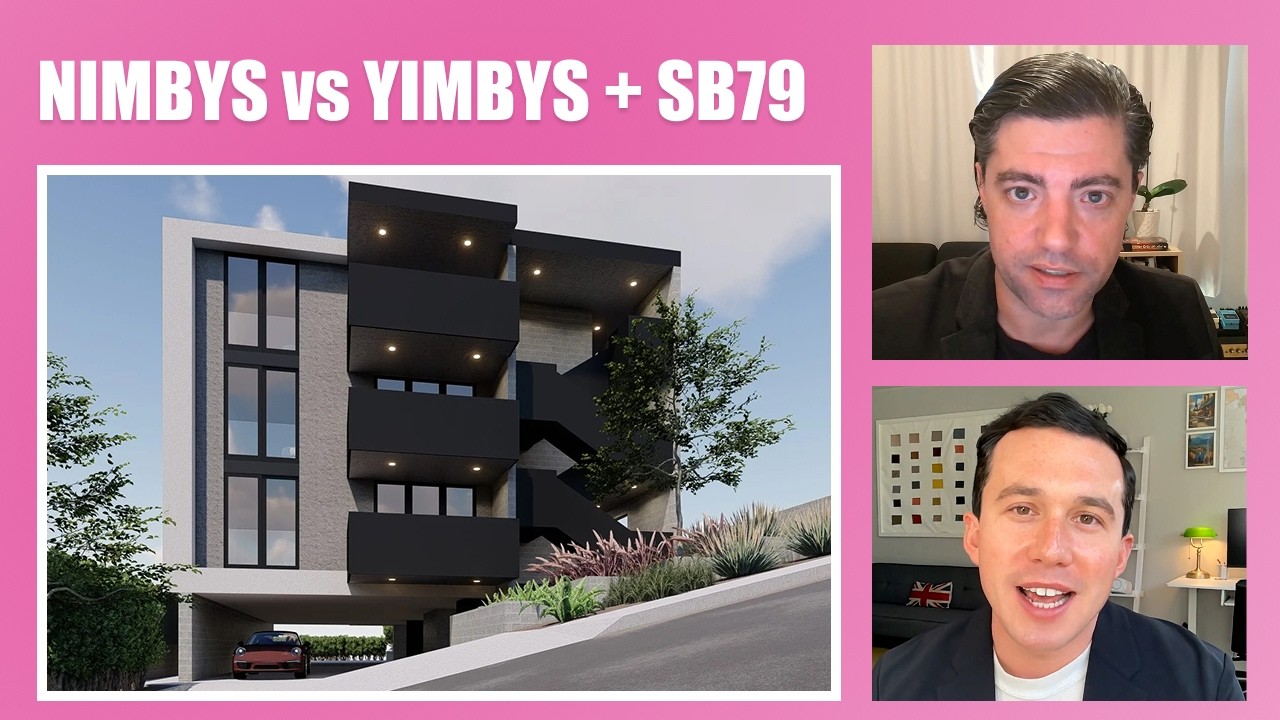
00:31BaileyGovernor Newsom of California just signed into law a major new housing package, 35 bills in total and they are set to take effect January 1st, 2027.
Some of these new bills are going to have major implications both at the state level of California, as well as affecting what San Diego property owners can actually build on their lot. So today, we're gonna be giving our initial first impressions on these new bills, and specifically how they apply to projects in San Diego.
So Sean, before we dive into it, can you just give us a brief overview of how you're seeing these, this new housing legislation at a high level?
01:16Sean CanningYeah, sure, Bailey. Um, so I guess this is gonna be like a reaction video because I've only been looking at these new Senate bills and Assembly bills for, the last day. so this really is just an initial reaction. I would say there's two or three of these that are gonna be really awesome for your type of projects.
And some of them actually clean up some of the, like, messier code language before. there's one in particular that has to do with ADUs that is gonna be super helpful because the way the code language is just written now, if you've been listening to this podcast for the last year, you know I'm really not a fan of the way it's written because it leads to so much confusion. And we brought that to everybody's attention, a year ago. And now, right now, I'm dealing with, two or three projects in permitting where the building department can't even understand what the state code or their municipal code is saying. So it's very frustrating. And one of these in particular I'm super excited about because it cleans that up. But in general, I will say I think the best way to start this video is I think the intent of all these is good, and California's great at suggesting things that are intended to be good. But where we typically fail as a state is how these get implemented. And, we'll get into that a little bit in the video because I think that's a really important topic
02:33BaileyYeah, it all sounds good in theory, but we'll see how it actually ends up in practice. But on that point that you mentioned, so we're kind of in this in-between area, so it's early October right now. A lot of this doesn't go into effect until the beginning of next year, 2027. So how would you be advising clients who are considering a project or maybe they have one in the works?
what should they be doing in this in-between time?
02:57Sean CanningI would probably move forward with your project unless it's something-- it's one of these things that is so specific that you can only do the project if it happens. let me give you an example here. Some of these refer to how a building department will issue a permit and what kind of timelines and what kind of information they'll provide you. I wouldn't wait around for this to be implemented at the city level. I would just move the project forward, and then if it does get implemented by the time you're in permitting or b- by the time you're halfway through permitting, hopefully you'll see some benefit from that. But I really just wouldn't wait around.
I'd move forward with your project unless it's so specific that you need this assembly bill to make it happen. Let me just break this down one more level here. what we're gonna look at today is a lot of these assembly bills and senate bills that are in different, parts of their pathway to becoming law.
Some of them are already signed into law. is all at the state level. Once this happens, once these become law, then cities, the municipalities like where... I live in the city of San Diego, so this is the one we're mostly going to be addressing here. It'll take them six to eight months to have meetings with their planning department, have meetings with their attorneys, and figure out how they're gonna revise this language so that they meet every part of the state requirements, but how it also interacts with the city of San Diego's municipal code. oftentimes, that, that... there's some conflicts between the languages that they use, and that's where really the rubber hits the road here. So to answer your question, I would say move forward with the project, but expect at least an eight-month delay before this stuff starts trickling down into the city of San Diego's municipal code.
04:40BaileyOkay. With that all out of the way and taken care of, let's jump into the screen share then so we can actually look at some of these bills. I say we take a look by most impactful to least impactful going forward as you see them
04:55Sean Canningmost impactful to least impa- impactful?
04:58BaileyYeah, let's start with the biggest ones first, in your view
05:02Sean CanningThis is probably the most significant right here, so let's start with this one. I'll make a little list here of the ones we're gonna cover. So this is Assembly Bill 956, and this one is already signed into law.
on, California YIMBY's website. this is a great resource for all this information, so I'd encourage everybody to go check out this information right there. Okay, so here is the summary of this one. It's called double detached ADUs
05:31BaileyYeah, and I will link this in the show notes in the podcast description if people want the more in-depth explanation. But basically for AB 956, so it allows up to two detached ADUs and stops HOAs, homeowner associations, from blocking ADUs that actually comply with the state law. So Sean, what does going from one detached ADU to two actually unlock on a typical San Diego lot, especially in this instance where HOAs can't get in the way anymore, at least in theory?
06:02Sean CanningOkay, forget the HOA thing for now. we'll get into that a little bit later. The first part of this is so important, and, the important thing here is to understand the way the code is interacting with the municipal code in the city of San Diego. So the big issue we're having right now is if you're trying to do an ADU project, the municipal code and the state regulations are saying there's basically two pathways.
Either you have a property with an existing single-family home or you have a property with an existing multi-family home. And then once you determine which of those two properties you have, you could follow that pathway. So currently, if you have an existing single-family home, you can only build one detached ADU, and then you can get a second ADU, but you gotta jump through so many hoops.
It has to be created within non-habitable space like a garage, or it has to be created within the existing single-family home. So the second ADU has to become some sort of conversion of existing space. And what that ultimately does, if you're trying to get two ADUs on a property that has an existing single-family home, you would first have to permit a garage, complete that permit, complete that construction, and then you can come back and complete that second ADU. And obviously, that's more moving pieces than you really need for the intent of the ADU code, because the intent is to get more housing, so why make more steps if you really want more housing? So the first way to look at this is if you have an existing single-family home or an existing single-family lot, you can skip all the noise and just do a single-family home with two detached ADUs. So that is super helpful because previously, like I said, people were jumping through hoops, people were trying to do a JADU, but this just streamlines that whole process and just cuts through all the noise. Now, there's an important distinction here, which was a huge gray area in the way the ADU code was written. the city of San Diego particularly, but also throughout all of California, you have properties that are zoned multi-family, but there's two detached single-family homes the lot Now, the reason this is confusing is because the zone is multifamily, so there's an expectation of more density. But by definition, because of the way the code was written, there is no multifamily dwelling unit on the lot. you would think the municipalities would say, "Okay, there's two single-family dwellings on the same lot. We might as well consider that a multifamily dwelling," because for all intents and purposes, it's exactly the same thing. But over and over again, we've seen the city of San Diego take the extreme conservative approach on this, and what they're actually saying is that two single-family dwellings on a multifamily lot only accounts a single-family dwelling, which means you can only use the single-family dwelling section of the code, so you're only entitled to one ADU that's detached. Now, I'm looking at this particular Senate Bill, 956, and it-- and all this was popping up in my Instagram algorithm, last night when I was researching this. saying this is gonna be great for people with single-family zoned lots. in City of San Diego, yeah, it's great for properties with single-family zoned lots, but more importantly, it cleans up the language for multifamily zoned lots where there's two, detached single-family homes.
Or in my own scenario here, I live on an RM-2.5 zone, multifamily zone lot, but I only have a single-family, home here. So my property development that I was planning, that we've probably addressed on a couple of these, I was planning to do one detached ADU, and then one garage, and then later come back and convert that garage. I don't have to do that anymore. Because of this, I can just jump straight to two ADUs. so what I'm seeing on Instagram, a lot of people talking about how this is gonna be awesome for single-family homes. This is actually going to clean up so much of the ADU language and provide tons more opportunity. other thing is here, this basically double downs, doubles down on my theory that there is no more single-family zoning in California. basically, throughout California, every property that's zoned residential can now have at least three units on it, so there's no more single-family zoning. And I think this is just the, probably the most important of everything we're gonna discuss today
10:36BaileyI agree. It sounds pretty massive. And I remember when we first started doing the podcast, I remember it had gotten cleared up, at least in San Diego, where it used to not always be that basically for the most part, anyone with a lot with one unit on it already could build at minimum one ADU. I believe that's correct, if I'm recalling correctly.
So now it's pretty major if you look at it, the evolution now, that you can actually, most lots, if not all, could build two detached ADUs. So just looking at the evolution is a pretty good step in the right direction
11:09Sean CanningAnd also, Bailey, this is a great, this is a great assembly bill to explain how the implementation works with these things. So in, I think it was, like, August last year, so about a year ago, a little over a year ago, s- the state ADU code changed to define th- your options by single-family home or multi-family zone, multi-family home. so it was basically like what w- options depended on what was existing on the property, and it was no longer dependent by the zoning. So that changed August, not last August, but the previous August. then we started to plan projects accordingly. We reached out to the city of San Diego's planning department, and they were telling us, "Yeah, two single-family properties are going to be interpreted as a multi-family, property, and then we can use the multi-family part of the ADU regulations." And ultimately, what we saw is when the municipal code changed, that wasn't the case. So there was actually, bad information coming from the building department until it made it into the code, and then once it made it into the code, the language was so vague we still couldn't determine what they were looking for. And now, over a year later, we have projects now in permitting where this is now becoming a thing. the main thing,the newest thing actually, and I hope this, this is cleared up as part of this, but everybody is having trouble determining what a detached ADU is. for example, is it considered a detached ADU if you take both of these ADUs and attach them to themselves? So can you just build a duplex of ADUs? Because technically they wouldn't be detached anymore, but they would be detached from the dwelling unit. And we have two or three projects right now where different municipalities, we're d- dealing with one in, El Cajon, and we're dealing with one in the city of San Diego. municipal departments cannot seem to figure out what exactly is a detached ADU. so we can default to the state's, ADU handbook, where it states that a detached ADU is detached from the, from the multi-family structure or from the single-family structure that allows the ADU to be resulted from that structure.
So Bailey, in a nutshell, the state has put together this language, but then at the municipal level, they are still struggling o-over a year later to understand the language and figure out how they're going to implement it. this shouldn't have... This should, should not be a surprise because, um, we typically see this.
But of course, there's so many scenarios, especially with the cottage court typology that's historically super popular in California. you know, if you have a cottage court that has 10 detached dwelling units, how many ADUs can you build on that? And the municipalities just haven't caught up with that.
So I guess the last thing to touch on here is the HOA restrictions, and we don't do too many projects within HOAs. In fact, it's like one of the first five questions on my project survey. I just like am diabo-biologically opposed to an HOA that is going to govern the design based on like arbitrary requirements.
But es- what this is supposed to do is somehow clarify, that ADUs are permitted on these lots and HOAs are not allowed to restrict them. And I think, uh, there's a actually a couple of these that we're gonna go through today that address that specific thing, HOA restrictions on ADUs
14:46BaileyOkay. move on to the next one then. So whatever you think is the second biggest deal to cover here. I will say it's interesting how you were talking about you would think passing these laws would clear things up and make the permitting and the regulation more straightforward, but it's interesting how one law gets passed, and then within that new law or the new regulation, there's so much room for interpretation, so much like politicking, I guess you could say, for lack of a better term, where it just invites more negotiation in some ways
15:17Sean CanningYeah, dude, we're working on one right now where, it's a cottage court. We're planning, seven ADUs that are gonna be built within existing garages. And, we had a meeting with the planning department, and we only referenced the state code, and they're like, "Well, why don't you open up the municipal code?"
And we're like, "Well, we don't wanna use the municipal code because the lang- you've changed the language in a way that y- c- you could easily argue what we're trying to do would not be permitted. But if you look at the state code, um, it's pretty clear that what we're trying to do is permitted." So the planning department wasn't as familiar with the state code as they were with the municipal code, but ultimately s- the state code is, is what is the thing that has to be followed
15:57Baileywe did an episode that I'll link below, but sometimes these planning departments at the local municipality level have their own agenda that's completely rogue sometimes from, the state or the city's agenda. So
16:09Sean CanningУгу
16:10Baileythat if anyone wants to check that out. But let's now move on to the next one, which is reducing the cost of ADU.
So sounds pretty good in theory. So SB1117 will make it less costly to build ADUs by removing an arbitrary financial penalty that many jurisdictions impose on ADUs over 750 square feet. So Sean, why don't you explain what this actually means?
16:37Sean CanningOkay, so this one's gonna be helpful outside of the city of San Diego, but not so helpful within the city of San Diego. So let me kind of break this down. Essentially, what is happening here is if you're building by-right ADUs, if you keep them under 750 square feet, you're exempt from impact fees. So there's this like hard line, this hard threshold at 750.
So that means that if you, if you're a developer or maybe you're a s- a s- a homeowner trying to get these things to pencil out, you really wanna keep the ADUs below that threshold of 750 square feet because then you avoid the impact fees. I mean, it makes sense. An impact fee, just so everybody is aware, is a fee that is implemented as a flat fee generally, and, this fee covers everything that your property taxes are supposed to pay for.
look at it as like a double fee. every new dwelling unit is subject to these fees, but ADUs that are permitted, by right from the state are exempt from these fees. The impact fees were becoming one of the top obstructions for new housing, and depending on the neighborhood you live, your impact fees can range from $5,000 to $50,000 per unit.
So obviously, if you're building two ADUs using the previous code, that's gonna become a financial obstruction, and the state really wants to eliminate these things. So in other municipalities, once you went to 750 square feet or 751 square feet, you would then pay that full impact fee. So let's say the impact fee is $10,000 per ADU.
everybody's dialing back their ADUs to 750 square feet, which is basically a two-bedroom. So the code was creating an obstruction to get three or four-bedroom ADUs, and those are needed because we have a shortage of, of units, three bedrooms and more. So, you know, if you're a, if you're a family of four, a two-bedroom ADU is gonna be tight, but a three-bedroom A- ADU may work.
And if you work from home, you know, an extra bedroom is super helpful. So essentially what this is saying is if you were to build that 751 square foot ADU, you're not gonna be subject to the full impact fee. You're gonna be subject to one square foot, in some sort of scaled manner of that impact fee.
So you're still gonna pay more, for the 751 square foot ADU than you would for the 750 or less ADU, but the penalty is not the full impact fee. So i- it's very logical, and I think this one makes sense. The reason this is not gonna be helpful in the city of San Diego- Is because we already do not pay impact fees for ADUs over seven hundred and fifty square feet if it's a buy right ADU.
But it will be really interesting to see if the city will adopt this for their ADU home density bonus program, although I suspect they may not.
but outside the city of San Diego, this would be really helpful in reducing fees.
19:44Baileywe've done at least one major deep dive on impact fees and how they affect ADUs, so I'll also link that below if people wanna dive further in. But for now, I'd say let's move forward into the next one. these are all ones... People can let us know in the comments if they want us to do a deeper dive on any one of these in particular. I'm sure we will over time
20:08Sean CanningOkay, so this one is really interesting. It'll be even more interesting to see how the cities, uh, how the municipalities roll this out
20:19BaileyOkay, so let's see. Predictable and clear infrastructure requirements. So SB 1014 would require cities to disclose all local requirements related to infrastructure like sidewalks and sewers within 30 days of a housing project's initial application, and prohibit cities from adding new requirements more than 30 days after a building permit application, except under certain circumstances. This bill will improve project certainty, reducing risk and cost. right, I see some gray area and some room for maneuvering there. So what's your,translate that for the regular person here?
20:57Sean CanningOkay, so this is something that we've identified as a major risk on any type of project in the city of San Diego. and I guess throughout the, you know, the, the entire state, but specifically within the city of San Diego. So if you're not careful with your developments, you can trigger something that's called public improvements.
And what that means is, in addition to all of the construction you're planning on-site, you're gonna have to do certain things that are off-site that are going to increase the cost of the project. So every decade or so, the city changes their standards for the sidewalk in front of your home.
sidewalk and street for that matter. So right now, we need ADA compliant crosswalks. W- Uh, they just changed to have ADA compliant curb cuts. So if somebody with a wheelchair is coming down the sidewalk in front of your home and your driveway,angles down and then angles back up, the new city standard has the sidewalk wind around that driveway curb cut so that they can pass on a level, path of travel, essentially.
additionally, there's some requirements for different types of street trees. so you have to have, you know, one or two or maybe more, depending on how much street frontage you have, of specific trees that are planted in a very specific manner with root barriers and different sizes and everything, and all that has to be,taken care of.
So the city's updated their standard for these sidewalks, and if you zig where you should've zagged during the course of your developments, then you need to have a budget for these types of improvements. so you can imagine somebody can be trying to do a small addition, trying to reduce costs as much as possible, and they make a mistake 'cause they don't understand where the threshold is here, and now all of a sudden they have to do like $50,000 worth of work on their sidewalk.
And that's not going to help people who try-- are trying to do small projects on a budget. now the big challenge we've had, the reason I have identified this as a risk, is because it's almost impossible to determine upfront what kind of public improvements are going to be required here. In certain scenarios, the municipality can actually say, "Hey, uh, we've increased the width of the right of way from property line, past the sidewalk, past the street, past the opposite sidewalk to the other property line."
And they're saying, "We've increased this, and now we need a dedication of your property to the city." So this is like, the stuff that keeps me up at night. You submit a project and the city's like, "Yeah, but we just need the front two feet of your property to be dedicated to the city, so we can approve your property."
it's something that you have to look out for, but it's almost impossible to look out for. We've asked the city specifically how to identify pro- projects that are gonna have these dedications, and there's about, like, eight different documents you have to cross-reference, and, basically nobody at the city can give you an answer upfront on this.
It's so complicated. So if I understand this Senate bill correctly, and this has passed into law, now within 30 days of your application, which is when you submit the permit, the billing department is gonna have to say, "You have to do these improvements," and in addition to that, they're going to have to provide you a construction estimate, of the cost of these.
that's really interesting because, uh, additionally here, if you read the language, they're not going to be able to change this later on. So, like, they can say, "Hey, you have to, meet the standard of the, the sidewalk," but they can't later on come back and say, "Hey, we forgot that you also have to repave the alley."
So that'll be super helpful because at least you'll get all these costs upfront. Now, the, the challenge is it would be really great to have this information before you even start the project, but it doesn't seem like that this is going to require th- that. But at least they're gonna start to itemize some of this information at the first round of plan check comments.
The gray area here is the building department is gonna have to provide a cost estimate, but they don't do the work. So you still have to hire, a contractor, a Class A contractor who's not part of the city to give the estimate. And I guess you could, like- Check their estimate against the city's estimate and see, and maybe you can say, "Hey, the city is saying it's gonna be this cost.
Why is your cost higher?" Or, "Why is your cost lower?" If you wanted to do that. So I think the thing that doesn't have any teeth here is that, the city would give an estimate that would have any relationship to,reality. Because, y- if the city of San Diego builds a bathroom, it costs like $1 million for like a public bathroom, so those are really high costs in comparison to what w- a private contractor would provide.
But if you look at the valuation table that the building department gives us, they're all-- they're actually way low on what, cost of construction is in the private sector. So I, I wouldn't expect the estimates to be, to be reasonable. So there's one piece of the puzzle here, which I hope this clears up, which is kind of not listed here, and you wouldn't know what this is unless you're in the thick of these types of projects.
But a lot of times what happens is we'll get an approved right of way drawing, and then when you go to build it, the inspector makes a bunch of changes to the approved right of way plan. And I hope this helps clean that up because that adds risk and cost to a project, and that is like, that is not the way the process should work.
You sh- you should submit your plans. It should be reviewed in plan check. The permit is issued. The inspector reviews the approved plans. But like I said, more and more what we're seeing on these right of way projects is you get the approved right of way pl- plans, the permit is issued, and then the inspector says, actually, I'd rather see it done like this."
And that is not the way the process should work. So hopefully this helps kind of prevent that from happening. Yeah.
26:53BaileyDefinitely.
26:54Sean CanningYeah.
26:54Baileyright, I say we move on to the next one. think it's fair to say that this was, like, the three biggest ones so far of the entire package?
27:02Sean CanningI think those are the three biggest ones, and there's one that hasn't passed into law that I would really love to discuss, but let me just scan through these and see what other ones are, are kind of worth discussing before we go into ones that have not passed into law. So you see this one here is, like, died on the floor.
It's not worth conversation. this one here, I'll just summarize this real quick. it seems to create some incentives, through a ministerial-type pers- pur- purpose for projects that are downtown, and it specifically itemizes San Diego as, like, one of the top, I think, eight or nine downtowns in California.
now I don't do too much work downtown because those are giant projects that require a ton of moving pieces, but hopefully this can incentivize projects to happen downtown, because we need to improve down- the, the downtown areas, uh, throughout California. we talked about this one already
27:53Baileythat's AB 2074 for
27:56Sean CanningYeah, 2074. let's take a look at this one, and this one was signed into law
28:05BaileyAll right, so SB 1116, Strengthening the Starter Home Revitalization Act. So this bill will streamline the construction of smaller, lower cost, quote, starter homes for homeownership by making several improvements to existing state housing law. All right, so getting a bit more specific, what exactly does this bill entail then, Sean?
28:30Sean CanningOkay, so this is specifically referring to town home designs. And, this is really interesting. See, the big issue we're having in California is nobody's building starter homes because the land is so expensive, if you only build a s- a small home, you never quite catch up to the, the amount you've paid for the land.
So the financial s- the financial, uh, structure just really Doesn't create any incentive for somebody to build, like, a 750 square foot home. that's different than an ADU, 'cause an ADU is, like, a second structure on the property. But nobody would just build one home that's 750 square feet if you're trying to sell the property because you just, um, you'd be losing money at that point.
So what this is supposed to do is create a ministerial process, which means, like, not a discretionary process, so, like, less approvals, and a buy right process to build townhomes which then could be used as, uh, starter homes. And more and more we're seeing, like, townhomes being priced lower than detached homes, so I think the townhome is a legitimate typology for a starter home.
And the interesting thing about this one is it's going to clean up some of the language from SB six eight four and SB 1123, which I believe we've covered on this channel before. But these two Senate bills, which are already in place here, these are gonna be, like, the shining beacon for these types of starter home projects, because both of these Senate bills...
Oops. SB 684 and SB 1123. This one is for single family zones. This one is for multifamily zones. Both of those allow for ministerial processes to subdivide a lot down to, like, 600 square feet, and I think this, this bill may even allow it to go lower than that. So it-- so you could have an existing, 3,500 square foot lot, which is, like, a common lot size here, subdivide it into 600 square foot lots, and then the starter home size makes sense.
And with this, it provides an avenue for not just detached homes, but for, townhomes, which are basically like side-by-side homes. So this is super helpful. I'm really interested. We still haven't seen 684 and 1123 trickle down into the municipal code yet, so I'm really interested to see how that is gonna happen, and I'm also interested to see how this Senate bill will affect those two, those two.
And then the last thing to just mention here is, in the city of San Diego, we've been working on the Houses for All of Us, program, which is kind of, like, starting to work its way through the discussion. And what I suspect is that the Housing For All of Us program is going to leverage both of these Senate bills pretty heavily.
Basically, it's a program that the mayor, Todd Gloria, is working on to allow for starter homes to happen. So there's, like, the Senate bills and this new program in the city, and when these two things get combined, hopefully good things will happen. It's still-- We still have a lot of time to figure out how all that will work though.
31:47BaileyOkay. it seems promising, I will say
31:51Sean CanningMm-hmm. So let's move on to another one of these, and let's see what's happening. So this is the one I'm super interested about, but it's held in committee, so it hasn't passed. So let's end on that one. But before we do that, let's just take a look if any of these other ones are going to be really important.
so let's see 677, which is signed into law
Okay, so cue me up on this one, Bailey
32:21BaileyEnding delays for more homes. So SB 677 will protect already approved housing projects from common delay tactics involving the creation of subdivisions and approval of federal financing for affordable housing. So what does that actually mean in practice?
32:38Sean CanningOkay, so we'll keep this one super high level, but I think what it's trying to do here is create ministerial processes instead of discretionary processes for lot splits. So if you were to try to take one lot or, you know, a l- may- maybe it's a giant lot and subdivide it so you can build multiple units, and this would be within, subdividing within the, minimum lot sizes that are al- are already established.
So just to create a distinction from 684 and 1123, which allow you to subdivide smaller than the standard, this is subdividing within the standard. it's basically taking out a lot of the, decision-making processes which delay these types of projects. So that's the way I understand this one at a high level.
so that would be good if it happens. We'll see what happens. let's go through a couple more of these. So pathway to affordable housing by raising current limits on the pilot. Okay, we'll skip this one 'cause this one gets a little technical. I'll go back to this one, um, in a second. So that's on the governor's desk.
This one has benefits to student housing, and that has passed the Senate, so it's still not in law yet, but that one could be beneficial if you develop student housing
This one's interesting, held by author, but I haven't actually gotten into this one too much. I think it sets up like a new committee. You know, we do this a lot in California, where like we're gonna have a committee for a committee for a committee, and it, it all gets kind of like tied up. and then all these other ones are listed as gut and amended, so we'll skip that one.
So I just wanna touch on two more of these. The first one is going to be this one here, and then we'll come back to the last one, 1070, which is appropriately named, and that's the most interesting to me. So here's AB 1621. We'll just go at a high level on this one, so cue me up here
34:38BaileyRight, sharpening the shot clock. So AB 1621 will tighten existing regulations that require jurisdictions to approve permits for new housing in a timely manner. regulations, also known as shot clocks, give builders greater certainty in construction timelines and prevent bad actors from indefinitely delaying new housing with arbitrary review processes
35:03Sean Canningthis is one that is great in theory. In implementation, it's going to be, difficult to enforce. what we have right now is you submit us, a set of plans, which they call an application for a building permit. And with ADUs, there is something called a shot clock now. So they have 60 days to review that application and then get back to you with essentially actionable plan check comments.
Now, what this is supposed to do is,enforce some of the, uh... Sort of tighten up some of the language, and I believe it brings the shot clock down from 60 days to 30 days, which would be awesome. I'm not sure if this is going to apply to dwelling units, 'cause currently the shot clock we have only applies to ADUs, and if you submit a project that has an ADU and a dwelling unit addition or a new dwelling unit, then the shot clock doesn't apply.
So I'm hoping this will kind of tighten up some of these things, because there's really no reason if the project is small for a municipality to spend 60 days reviewing a plan check. The longer you go, the more difficult it is for anybody. So, like, here's my example that I always use here. So Bailey, if I gave you a really complicated math problem and I said, "Hey Bailey, um, finish this math problem and provide me an answer."
And then 60 days later, I went to you and I said, "Hey Bailey, this is the answer you provided. How did you get here?" It's gonna take you so much more time and effort to go back through your work 60 days later than it would've if I came to you one day or one week later, right? Because you gotta revisit everything.
So to have these like extended permit periods doesn't really help anybody. It's not making anything more efficient. It's actually only making things less efficient, and it's making us all work harder on these things. It's al- it also makes the building department work har- harder, because now they have to revisit just the same as you would have to revisit things.
Now, the reason this is going to be difficult to implement is, first off, the municipalities have interpreted this to mean the shot clock starts when they accept the application, not when they receive the application. So we submit a building permit, and they say, "Okay, you're in the, um, like basically upload phase, and we haven't completely checked to make sure it's complete," which can take like a month.
And then once they check it, they're like, "Okay, your application is deemed complete, and now we're gonna start the shot cl- we're gonna start the 60-day shot clock." So there's no limitation for... Actually, it's called intake. There's no limitation for the intake phase. And then at the end of the process, after you're all approved, you have the, issuance phase, and that one generally runs fast.
But, I don't think this refers to the, issuance phase where you set up, settle up all your fees. So I'm hoping they kind of tighten this up because in my opinion, as soon as I give you The application, that should start the shot clock. Um, now the reason this is gonna be hard to implement is because more and more of what we're seeing is, "Hey, we forgot to assign this department to review your plans, so now we're gonna assign that department."
And it's like, what? You already missed the 60-day shot clock. And they're like, "Well, yeah, well, we're gonna start reviewing that today, and that's gonna start the shot clock," which I kinda disagree with. And the other issue that, you know, you end up with here is if they miss the shot clock, you end up in a situation where you're supposed to be able to use something called builder remedy to construct your project without a building permit, but you're still subject to all the building code, and that just leaves this, like, giant gray area.
can you imagine the, the plan check doesn't occur within the shot clock, and then you're like, "Hey, don't worry about the rest of the permit. I'm just gonna go ahead and build this thing. Send the inspectors out when it's convenient." And then the inspectors are gonna get there. They're gonna be like, "Wait, what's going on here?"
it just opens up, like, a huge pitfall. So, um, yeah, that one, it's great. I don't know how they're gonna implement it. We'll see. So I know we're running out of time here, and I really wanted to cover 1070, since it's the name of, since it's the name of my business, and I think this one is actually really interesting.
So I'm gonna click on this one and then give us a summary here, Bailey
39:29BaileyAll right, so AB 1070, building codes for, quote, "missing middle housing." So AB 1070 will make it faster and cheaper to build small multifamily homes by requiring the California Department of Housing and Community Development, the HCD, to study changes to the building codes that apply to smaller housing projects. right, Sean, what does that mean?
39:54Sean CanningOkay, so this one is huge, but I should note here that where it's at right now is it's held in committee, so this is not actually officially law. Okay, right now there's a huge threshold in a project between the California Residential Code, which is easy to, satisfy, and California Building Code, which is harder to satisfy.
So here's a great way to explain this. California Building Code essentially covers every type of construction project, with the exception of single-family and duplex projects. So if you're gonna do a giant commercial, um, let's say a, a mall, that's California Building Code. If you're gonna do a hospital, one of the most complicated projects possible, that's California Building Code.
If you're gonna do a freaking airport, basically the most complicated project you can do as an architect, that is California Building Code. And on the f- on the other side of the spectrum, if you're gonna do a small residential triplex, you're governed by the same exact code as these giant projects. So our strategy at 10 70 Architecture has always been keep this...
keep the projects as simple as possible, so we like to design California Res- to California Residential Code. And to do this, that means we're not doing triplexes, we're doing duplexes. And we have been doing lots of duplexes on the lot, which still keeps you in California Residential Code, and I look at it as probably the best angle for any small-scale developer, especially in-field developers, is to just do a series of duplexes.
but what this essentially would do is move the threshold for California Residential Code from a maximum of two units in one structure to potentially 10 units in one structure. So that would be, like, so awesome because you would've eliminate a lot of the, uh, more restrictive codes that are stopping these projects from happening.
Now, I wanna show you one of the issues here. I'm gonna actually open up the text, and this is something that we're plagued with in California. so like I said, this is not actually law yet, and what this is requiring... I wanna see. Ch-ch-ch-ch I wanna see where this section I was looking at earlier was.
Okay, so what this is actually saying is th- no later than December 31st, 2028, so more than a year from now, the department shall include a completed study, um, and basically they're gonna complete a study. So they have over, over a year to just complete the study, and that's what this is saying. so this is not a guarantee.
Is that two years? 'Cause let's see, December would be 20- Yes, you're right, two years. So this timeline is like crazy, but this is how long it takes for this stuff to actually work, and we need this right now. Like we're in a housing crisis for like over 12 years. We can't wait two more years for this stuff to happen.
We just need it to happen right now. So this is, uh, these types of timelines are just something that drags along so much and it just plagues California because it takes so long to put these things into play. And then even after you put it into play, it takes another year for it to trickle down to the municipal level so you can actually use it.
43:34BaileyYeah, and plus by then there will be a new governor, so who knows what's gonna be going on with that. So a lot could change between now and then basically.
43:42Sean CanningMm-hmm.
43:43BaileyI would say, like I was talking to you before, when I first was reading through this I didn't think it'd be much of a big deal, but as we've, shown I think it actually is a pretty big deal.
So if you're a NIMBY right now, I can't imagine you're too happy. There was definitely a couple of Ls taken, but it is what it is. so basically in conclusion, what are your final thoughts here on everything we just covered?
44:05Sean CanningSo there's definitely some super exciting stuff coming down the pipeline. I hope we implement this stuff well, because in the past we've failed to do that. But hopefully, um, this is implemented well. Because of how long these things take, these have been in the pipeline for, years, and finally they're starting to come through.
so over and over again, the thing we're hearing from the state is we need more housing. We're failing on housing. this is resulting in a housing crisis and a fi- and a, um, affordability crisis, and we need the municipalities to just understand the intent of these codes because, it doesn't help anybody to look into the nuance of, "Hey, you have two detached single-family homes, so we're not gonna allow you to apply the multi-family housing regulations for the purposes of ADUs."
you-- They're missing the entire intent of what the state is telling us, and you can go into these state documents, and you can clearly read the reason they're doing this is because of how we're failing the population of California with housing supply. so let me just put a pin in this here.
I'll say this is good information coming from the state. We need it to happen faster. We need the municipalities to implement it better. But everything is trending towards more housing, easier housing, and reducing the speed bumps along the way. So let's do it.
45:31BaileyThe trend lines are positive. I think we talked earlier, there was like that viral article that went viral earlier this year. They were talking about how in Korea, in Pyongyang, their capital city, they literally built more housing last year than in all of Los Angeles. So that's obviously not a good metric.
That kind of just illustrates the current predicament, but hopefully these new bills work to improve on that. If anyone listening has been inspired by this to consider a development project that they've had, in the works, explain to them what are some ways they can get involved with working with you and your studio as we wrap up here?
46:06Sean CanningYeah. So if you have a single-family zoned property or a residential property that has only an existing single-family home, you now have lots more opportunity than you did last week. so if you wanna get in touch with me, visit 1070architecture.com. There's a section there where you can fill out a project survey, and you can schedule a no-obligation discovery call, so we can talk about your project specifically.
Also, visit 10-- uh, the Instagram page, which is @1070architecture, @1070architecture, and we put a lot of good information there. And also check out the other videos in this, on this YouTube page. And if you have more information about any of this or you have questions, put it in the YouTube comments. I'm really interested to see what you think about this
46:47BaileyYeah. Sean responds to the comments, so you'll probably get your question answered if you have one. Otherwise, I'll link everything that we've mentioned throughout this
episode in the description. Thanks for watching everyone. We'll see you next time